View all Professional Packs

Free Professional Pack · English edition

Cybersecurity & Incident Response

For finance, procurement, treasury and security teams worldwide.

Module 1: Responding to a Suspicious Supplier Bank-Details Change

This first module focuses on suspected supplier-payment fraud.

You will produce an incident record and a management update.

Start the practice caseNo account or AI key requiredChoose your job

Read the procedure, verify the evidence and work through two fictional rounds in your browser.

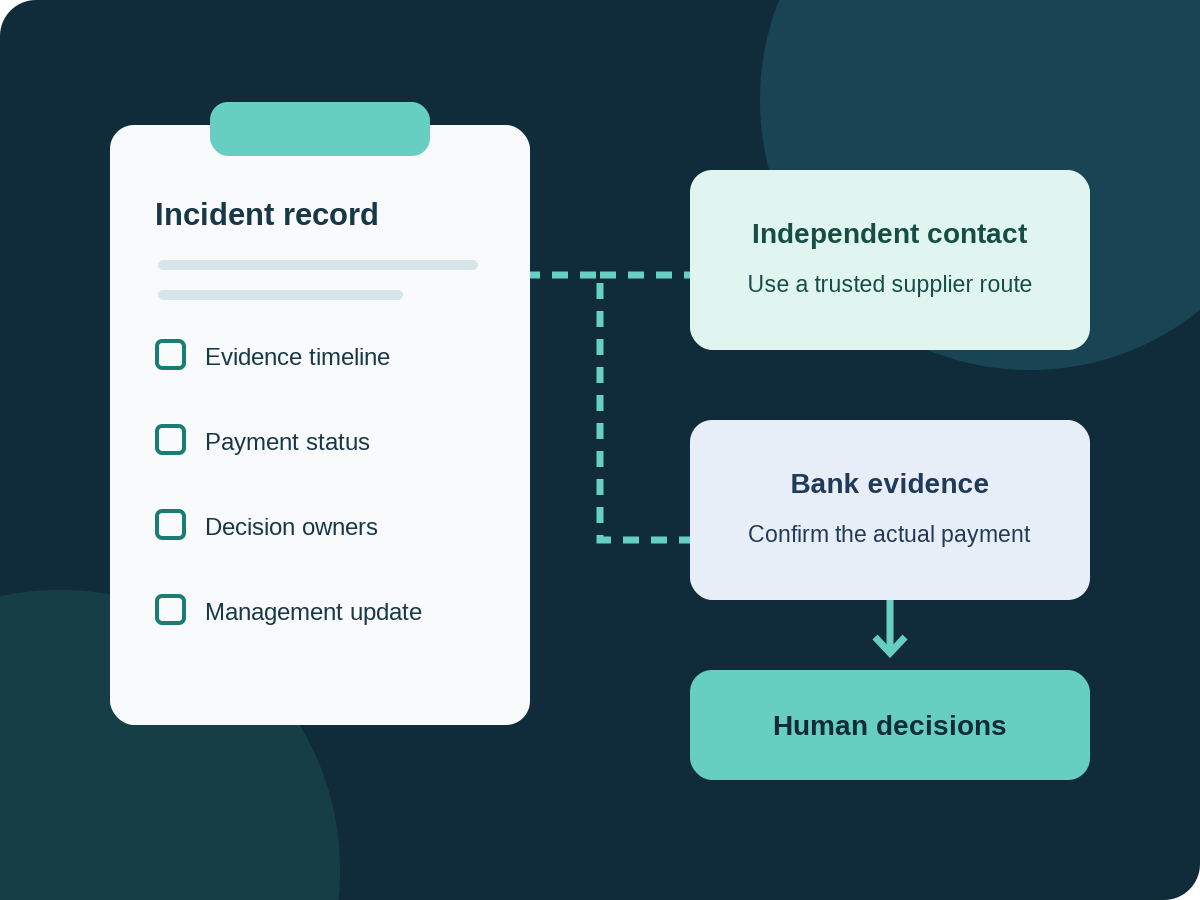
Illustrated response desk linking an incident record, independent supplier contact, bank evidence and a human decision
Explore this pack in ChatGPT (opens in a new tab)

Once connected, ask:

Show me the Cybersecurity & Incident Response Professional Pack.

Response procedure

For an actual incident, follow your organisation’s authority and verified bank escalation route. Do not wait for this exercise or an AI draft before seeking urgent bank assistance.

Read the complete procedure

Edition 1.1 • 19 November 2026 • English • Global core; local adaptation required

Purpose and starting point

Use this procedure when a supplier or vendor appears to request changed bank details, especially near a payment. It supports finance, procurement, treasury and security teams in deciding what must be verified, protected and handed over. The request may be legitimate, fraudulent or unresolved. Neither a familiar sender address nor an approved invoice proves that new bank details are genuine.

Start now: report through your established incident route; ask the authorised payment owner to protect any payment still capable of being stopped; ask treasury to obtain current transaction-level bank evidence. Do not wait for a complete record, an AI response or proof of mailbox compromise before seeking time-sensitive bank assistance.

Use the editable incident record. Fill missing information with the stated empty values. The record documents work; it does not itself perform a hold, payment change, recovery request or notification.

Role and authority map

Map these functions to actual roles, deputies and contact routes in section 1 of the record. One person may hold several functions in a small team, but record that fact and retain the organisation's required independent approvals. Do not create authority by filling in this table.

Function Work owned Authority boundary
Reporting finance officer Report the request and preserve accessible originals without altering them May raise concern; may not assume authority to change banking details or release funds
Incident coordinator / finance lead Coordinate immediate exposure assessment, handoffs and management updates Uses existing authority for holds; escalates decisions outside that authority
Procurement / supplier manager Independently contact the established supplier representative Verification is distinct from approving a beneficiary change or payment
Treasury / authorised bank user Obtain authoritative transaction information and contact the bank Exercises documented standing/emergency authority; bank determines available intervention
Authorised IT/security custodian Preserve technical evidence and assess systems within authorised scope Does not access the supplier's systems without authority or infer compromise from the payment request
Legal/privacy/compliance owner Assess applicable reporting, disclosure, legal holds and retention Determines applicability from actual jurisdictions and facts; no universal deadline is supplied here
Authorised finance approver / management Decide changes, release, expenditure, communication and closure within remit A case record or AI recommendation is not approval

If the usual owner is unavailable, use the established deputy/emergency route and record who accepted the handoff. An unknown role is an urgent escalation gap, not permission to self-authorise. Use existing standing authority for protective bank contact; do not invent a new approval hurdle that delays it.

1. Receive, timestamp and assess immediate exposure

Owner: reporting officer and incident coordinator. Inputs: reported communication, invoice, available payment information and authority map.

  1. Record when the request was received and reported, preserving timezone. Identify the buyer, supplier, invoice, amount/currency and account references without unnecessarily copying full bank details.
  2. Separate what the reporter personally did from what anyone else might have done. “I did not change it” does not rule out another user, delegated approver or automated process.
  3. Ask the authorised owner to consider a hold on relevant pending payments and supplier-record changes. Record the scope, request time and recipient. Record a hold as effective only when the responsible system/owner explicitly confirms implementation and scope; receipt of the request alone is insufficient.
  4. Ask treasury whether a payment may already have left. If diversion is suspected and a payment may be in flight or sent, treasury should contact its verified bank channel promptly under existing authority while confirming status.
  5. Notify the established security/incident route and assign the coordinator, next update and outstanding decisions. Do not reply to the suspicious message to verify it.

Output: intake in record section 1; requested actions in section 5; explicit unknowns in section 6. Human decision: immediate protective measures, incident priority and scope. State the supporting evidence and authority separately from execution evidence.

2. Preserve evidence while protective work continues

Owner: authorised security and finance custodians. Inputs: original message, invoice, supplier records, approvals, logs and bank records available within authorised access.

  1. Retain the original message, full headers and relevant attachments in the approved system. Do not open unexpected links or attachments merely to complete this exercise. Security staff decide any safe examination method.
  2. Preserve relevant supplier-master history, bank-beneficiary changes, user/approval history, payment-batch and individual transaction records. Record what was requested but not obtained.
  3. For every item record its source/custodian, event time, source/capture time, what it supports, limitations and preservation state. Preserve original timezone information; label any conversion. Unknown times remain Not supplied.
  4. Keep originals unchanged. Redact only authorised working copies, retaining the relationship to their originals. Record access and transfers according to the organisation's evidence procedure. Hashes are useful only when actually produced by an authorised process; never invent them or claim legal chain-of-custody compliance from this template.
  5. Record where evidence is retained and who controls access. Refer retention, deletion and legal-hold questions to the responsible owner; this module specifies no retention period.

Output: section 2 evidence/timeline and custody fields. Human decision: authorised collection, access, disclosure and containment. Evidence preservation and urgent protective action run together; the security lead balances any conflict and records what was done before alteration.

3. Independently verify the supplier's request

Owner: procurement/supplier manager. Inputs: approved supplier record and a previously verified contact channel independent of the suspect request.

  1. Obtain the contact route from controlled onboarding/master records or another independently established source. Record that source and its verification history. A new number, reply address or link in the suspect email is not an independent route. If the existing record's integrity is uncertain, escalate and establish another trusted route.
  2. Initiate contact through that route. Confirm you reached the appropriate supplier role; do not treat an unsolicited return call or an email reply as sufficient by itself.
  3. Ask whether the supplier requested a change, who authorised it, the effective date and which invoice/account references it concerns. Follow the organisation's secure method for any full bank details; do not copy them into an unapproved AI tool.
  4. Record the response and how the respondent's role was established. If unreachable, inconsistent or doubtful, keep verification unresolved and tell the payment owner. Supplier silence is not consent.
  5. Submit any apparently genuine change to the existing beneficiary-change approval process. Verification, supplier-master editing and payment release are separate decisions. Where payee-checking services exist, record their scope; a match does not by itself authorise the change or prove invoice validity.

Output: section 4 callback record. Human decision: whether the change is accepted/rejected/deferred under local policy, and whether further investigation is required. A supplier's denial is evidence of that statement, not proof of which mailbox or person caused the event.

4. Establish payment status and take the appropriate bank path

Owner: treasury/authorised bank user. Inputs: transaction-level bank evidence linked to the invoice, amount/currency, beneficiary and payment method.

Obtain the bank's original status wording, the time it describes and the time it was obtained. Link the specific payment rather than relying on a batch acknowledgement. An ERP state, payment instruction, approval or “batch accepted” message alone cannot establish whether funds were sent. Preserve discrepancies; ask the bank to clarify ambiguous or conflicting records instead of choosing the most reassuring one.

Original transfer status: Unknown; Not sent — bank confirmed; Pending — bank confirmed; Rejected — bank confirmed; Cancelled — bank confirmed; Sent — bank confirmed; Beneficiary credited — bank confirmed; Unclassified — clarification required.

Intervention kind: Unknown; Hold; Recall; Other — describe. Intervention status: Unknown; Not requested; Requested; Acknowledged; Confirmed; Declined; Unclassified — clarification required.

Recovery outcome: Unknown; No return — bank confirmed as of stated time; Partial return — bank confirmed; Full return — bank confirmed; Return confirmed — amount unknown; Unclassified — clarification required. Funds withheld status: Unknown; None withheld — bank confirmed as of stated time; Funds withheld — bank confirmed; Released — bank confirmed; Unclassified — clarification required.

Mailbox assessment: Not assessable from supplied evidence; Suspected — evidence stated; Confirmed — authorised security finding supplied.

Track the original transfer, each bank intervention and recovery independently. These are working classifications, not universal bank or payment-system codes. Use Unclassified — clarification required when local wording cannot safely be mapped; retain it verbatim and assign a clarification owner. Do not translate a rejected recall into a rejected transfer. A cancellation/rejection label does not erase earlier sending or prove the funds never left; record the bank-confirmed scope and reconcile any conflict. Beneficiary credit is not money returned to the buyer.

For each axis retain the bank's exact wording, evidence source, event time, source/obtained time and next responsible person/check. Repeat intervention records for separate holds/recalls and recovery records for separate credits; distinguish each credit from an evidenced cumulative total to avoid double counting. Keep every observation in section 2 and preserve earlier round records. Acknowledgement confirms receipt of a request, not implementation. Confirmed applies only to the exact intervention evidenced; it does not prove returned funds. Record internal holds in section 5 rather than presenting them as bank action.

Funds withheld are not funds credited back. Record withheld status and amount separately from return outcome and amount actually credited back. Amounts remain Unknown unless supported, including where a partial return is confirmed but its amount is not supplied. Do not infer zero from an absent return entry, or a full return from a recall reference. Record currencies, credit destination and transaction linkage; do not calculate residual loss or aggregate incompatible currencies from incomplete evidence.

When the bank confirms sending, acknowledges a recall and supplies no evidence of returned funds, communicate: “Transfer sent. Recall acknowledged. Recovery unknown.” Amount actually credited back remains Unknown. In section 7 repeat the three independent positions with their evidence locators and as-of times; never collapse them into “recovered” or “stopped”.

Established position Human response and evidence required
Unknown or Unclassified Obtain transaction-level bank clarification promptly; seek available protective intervention through existing authority where exposure is plausible.
Not sent, rejected or cancelled — bank confirmed Establish which instruction and stage the bank describes. Preserve any earlier sending evidence. Confirm remaining exposure and any effective protection; independent beneficiary verification and approval still apply before a new payment.
Pending — bank confirmed Ask the bank which intervention options apply to this payment method and record the precise response. An internal cancellation does not prove bank implementation.
Sent or beneficiary credited — bank confirmed Establish the actual beneficiary and exposure. If disputed, promptly request the applicable bank intervention through the verified route. Sending and credit are different facts; neither guarantees or rules out recovery. Do not request an unjustified recall of an evidenced legitimate payment.
Recall/hold requested, acknowledged or confirmed Record the exact bank-confirmed scope and next check, separately from original transfer and return evidence. An acknowledged request is not an effective hold.
Funds withheld or a documented return Record withholding and actual credit back independently. Reconcile each evidenced return, including partial returns, without erasing the sent history. Authorised people decide remaining recovery work and legitimate-invoice settlement.

Output: timestamped payment snapshots in section 3 and bank actions in section 5. Human decision: bank instructions, any replacement payment and accounting treatment remain with authorised people. No recovery window, eligibility or reimbursement is promised.

5. Coordinate security, financial and reporting handoffs

Owner: coordinator, with treasury, procurement, security and legal/privacy. Inputs: current record, evidence links, payment facts and relevant jurisdictions.

Keep mailbox assessment separate: Not assessable from supplied evidence; Suspected — evidence stated; Confirmed — authorised security finding supplied. A convincing sender address, supplier denial or diverted payment alone does not confirm compromise. Authorised security personnel decide investigation/containment and coordinate with the supplier through trusted channels. Preserve relevant evidence before changes where practicable; urgent containment remains a human risk decision.

For each handoff state what is needed, who owns it, when requested, whether acknowledged and the next agreed check. Escalate unanswered urgent handoffs through the existing route. An email sent to a team is not proof that someone has accepted ownership.

In section 6, ask the legal/privacy/compliance owner to establish any bank, insurer, contractual, police, regulator or privacy reporting requirement. Record jurisdiction, trigger, source, recipient, deadline and its clock-start event, owner and decision. Use Pending where applicability is unresolved. Country-specific guidance must be labelled with its jurisdiction, source and review date. English language or USD currency does not select a country's law. No global reporting deadline or automatic data-breach determination is made here.

Output: section 5 action/handoff records and section 6 requirement assessments. Human decision: containment and notifications under actual authority. Do not let an unresolved reporting assessment delay bank contact already authorised under standing procedures.

6. Give management a usable handoff and maintain the record

Owner: coordinator; review by the appropriate finance/security leads. Inputs: the latest evidence-backed record and unresolved decisions.

State original transfer, bank intervention and recovery separately, with evidence locators, as-of times, amount actually credited back (Unknown if unsupported), unresolved questions and next owner. Retain the bank’s scope; acknowledgement or withholding is not a return.

Draft a short update: what is established; what remains unknown; payment/exposure status and its timestamp; completed versus proposed actions; decision owners; next check. Link evidence and disclose limitations. Do not call the supplier's mailbox compromised, the incident closed or funds recovered without the relevant evidence and authorised decision.

Use section 8 to record receiving owner, handoff acknowledgement, evidence location, outstanding work and closure authority. Keep closure Pending while unresolved work lacks an accepted disposition. Administrative closure, financial reconciliation, technical investigation and reporting decisions are distinct; closure does not mean every uncertainty has disappeared. The responsible human determines whether unresolved work can be transferred and on what terms.

Preserve earlier assessments. A later source can establish an earlier event: append it with both event time and received/source time, and explain the revision. Do not rewrite a Round 1 unknown as if it had been known from the start.

Completion and AI use

For a working handoff, every section must be present, consequential claims linked to evidence, unresolved items owned, and requested actions distinguishable from performed actions. Pending is an acceptable recorded state; it is not completion of the underlying work.

The optional Prompt may draft from material already approved for that tool. Use synthetic or minimised working copies; no passwords, credentials, unnecessary bank numbers or private mailbox exports. If disclosure authority or tool suitability is uncertain, continue manually. No AI output authorises verification, payment, escalation, notification or closure.

Source basis and limits

International core: INTERPOL — Business Email Compromise Fraud (opens in a new tab), supporting independent-channel checks and prompt bank contact. Australia-specific source: Scamwatch — Business email compromise scams (opens in a new tab), supporting independent contact for changed payee information. France-specific source: Cybermalveillance.gouv.fr — Fraude au virement ou faux RIB (opens in a new tab), supporting preservation of relevant messages and transaction material. This procedure does not import those countries' reporting routes into a global rule. Sources checked 19 November 2026. Source-grounded editorial desk review and author walkthrough completed; no independent practitioner review or certification is claimed. Local applicability and bank procedures require authorised human review.
Download the response procedure (Markdown)

Templates

Editable incident record

Use fictional evidence in the browser exercise. Keep actual incident records in your approved private system.

Editable eight-section workbook with independent transfer, intervention and recovery records, exact bank wording and sources, callback, decisions and management update. Local contacts, payment methods, roles and reporting routes remain editable. Browser and two-round Word versions are available on the pack page. Keep all eight sections, including the management update and continuing handoff. Missing evidence stays explicit.

Fictional learner exercise

Practice Cases

Module 1: Responding to a Suspicious Supplier Bank-Details Change

Read the procedure, examine Round 1, and replace the workbook’s empty values with your assessment. Write the management update in section 7. Download your Round 1 record before continuing.

Edition 1.1 • 19 November 2026 • English • Fictional learner exercise

Everything in this case is fictional: organisations, people represented by roles, messages, transactions, records and contacts. Account tokens and training contacts are not operational banking details. No real calls, payments, account changes, provider requests or notifications should be made.

Your assignment

You are preparing the incident coordinator's working record for Cedar Field Services, a fictional buyer. Its established supplier is Larkspur Supplies. Use the response procedure and blank editable incident record. AI is optional and unnecessary. No facilitator answer is needed to submit your work.

The case uses USD 12,500 and UTC for clarity. Currency does not select a jurisdiction. Countries, payment scheme and legal reporting requirements are deliberately not supplied; identify the responsible owner and missing evidence rather than choosing a country's rules. All case events are on 2026-11-17 unless another date is explicitly shown.

You may recommend decisions and simulated next actions; label them Proposed or Pending. Do not report a call, approval, hold, notification or other action as performed unless a supplied card establishes it. A useful answer can finish with unresolved questions.

Use supplied labels CASE-E01 through CASE-E09. These identify evidence cards, not the order in which events occurred. CASE-E07 is provided in Round 1; CASE-E05 and CASE-E06 arrive in Round 2.

Round 1 — information available at 2026-11-17 09:10 UTC

Complete and save Round 1 before revealing Round 2. On the website, use the editable browser record below the evidence. In this download, stop at the Round 1 submission instruction before reading ahead.

CASE-E01 — reported email

Event time: 2026-11-17 08:48 UTC. Available by: 09:10 UTC. Source/custodian: finance officer's reported message excerpt; original remains in the buyer's mail system. Original headers and an independent technical analysis are not supplied.

From: Accounts Team [email protected] To: Finance Team [email protected] Subject: INV-482 — updated payment details

Please pay today's invoice INV-482 for USD 12,500 to replacement account NEW-B instead of OLD-A. Our telephone service is unavailable today, so please confirm the change by replying to this email. Please use the new account for this payment to avoid delay.

The .example addresses and account tokens are fictional. No attachment or live link is supplied. The visible sender line is part of the reported excerpt, not a finding about the message's technical origin.

CASE-E02 — prior supplier-contact and approved-account record

Source/custodian: procurement's controlled supplier record V-017, excerpt supplied at 09:10 UTC.

Field Supplied record
Supplier Larkspur Supplies
Onboarding approval date 2026-06-02
Established contact Credit Controller, reached through supplier switchboard TRAINING-CONTACT-01
Contact provenance Approved onboarding contact; procurement recorded a successful verification call on 2026-10-18
Approved account token in this record OLD-A
Current change request verification Not performed on the supplied record

TRAINING-CONTACT-01 is a non-dialable exercise route. In a real incident, use the controlled actual contact. This prior record does not establish whether someone subsequently changed another system or sent a payment.

CASE-E03 — intake chronology and invoice information

Source/custodian: Finance Lead's intake compilation, issued at 09:10 UTC. The invoice and goods receipt were approved before inclusion in the payment proposal. That approval did not authorise a bank-detail change. The relevant invoice is INV-482, supplier V-017, USD 12,500.

Event time, 2026-11-17 UTC Supplied observation
08:35 Invoice INV-482 proposed for payment in batch B-204.
08:40 ERP extract showed beneficiary OLD-A and status “Awaiting release.”
08:48 Reported email received; see CASE-E01.
08:55 Integration message: “B-204 accepted.” No individual transaction outcome accompanied it.
09:04 Finance officer reported the request to the Finance Lead and said: “I have not changed the supplier record myself.”
09:08 Finance Lead instructed treasury to hold any remaining INV-482 payment activity and procurement to hold related supplier changes pending review. No implementation acknowledgement is supplied.

The compilation does not include individual user logs, current bank transactions or proof that the hold took effect.

CASE-E04 — treasury's payment-status note

Source/custodian: Treasury Officer. Note time: 2026-11-17 09:09 UTC; available by 09:10 UTC.

I have the 08:40 ERP extract and the batch acceptance message only. I have not yet obtained the bank's individual transaction record or confirmed its current beneficiary. I cannot confirm whether INV-482 was sent, whether another user changed bank details, or whether the hold was implemented. No bank recovery response is supplied with this note.

No transaction-level bank confirmation is included in Round 1.

CASE-E07 — fictional role and authority note

Source/custodian: controlled training authority note, effective 2026-11-01; supplied by Finance Lead at 09:10 UTC. This is fictional organisational policy, not a statement of law or standard banking practice.

Role Supplied authority for this exercise
Finance Lead Incident coordinator for a reported supplier-payment concern; may direct holds on remaining internal payment and supplier-change activity; coordinates updates.
Procurement Officer Independently verifies supplier requests using the controlled contact record. May not approve bank-detail changes or release payments.
Financial Controller Approves or declines supplier-record banking changes after required verification; no approval for this request is supplied.
Finance Director Separately authorises payment release, management distribution and incident closure; no such case decision is supplied.
Treasury Officer Standing authority to obtain bank records, report suspected diversion and request available protective/recovery measures without waiting for a new payment-release approval. No authority to promise recovery.
Security Lead Authorises evidence collection in buyer-controlled systems and proportionate containment under the incident procedure; supplier-system access requires separate authority.
Legal/Privacy Lead Establishes applicable legal, regulatory, contractual and insurer reporting duties and disclosure/retention decisions.

Bank contact: BANK-TRAINING-01, a non-dialable simulation route representing the verified contact in the buyer's approved bank profile, checked on 2026-11-02. The route is available for this exercise. Backup, hours, bank country and named payment scheme are not supplied. Emergency deputy route: the established internal duty-manager route, represented by DUTY-TRAINING-01. Both are simulations, not real contact details.

Payment context: electronic bank transfer; the named scheme and domestic/cross-border status are not supplied. Buyer/supplier/bank jurisdictions, reporting rules and retention periods are not supplied. Learners must retain those gaps. The coordinator requests a first working assessment at 09:10 UTC and a revised assessment at 09:30 UTC; these are exercise checkpoints, not statutory deadlines or a reason to delay urgent action.

Round 1 submission

Complete all eight workbook sections as CFS-INV-482-R1, cutoff 2026-11-17 09:10 UTC. Identify what the evidence currently establishes, the decisive missing payment evidence, the independent callback route, actions that are merely requested/proposed, decision owners and the next check. Draft a management update of no more than 150 words with evidence references.

Submit or save your record unchanged before continuing. Do not invent missing local rules to make it appear complete.


Your Round 1 record

These fields are for fictional practice. This workspace does not send your entries to Amo.ng or an AI provider and does not save them in browser storage. Download or copy your work before leaving or refreshing the page. Website usage and security logging still follow the Privacy Policy.

The completed Word document includes Round 1 and, once revealed, your separate Round 2 record. Both assessments remain in their original order.

Click or tap an answer to edit it. Use Tab to move between answers and Enter for a new line. Pasted text keeps its words and line breaks; formatting is removed. Headings and instructions stay fixed.

Supplier Payment-Change Incident Record

Edition 1.1 • 19 November 2026 • English • Global core; local adaptation required

Use with the response procedure. Copy this template into an approved private location. Retain sections 1–8. Replace the initial values and add rows as needed. Each record is an as-of assessment: retain the earlier record when new evidence changes the position. This document does not calculate, contact anyone or execute actions.

Empty states: Not supplied = missing evidence/data; Not performed = check not undertaken on the supplied evidence; Pending = decision not evidenced; Unassigned = owner not established; To be agreed = arrangement not agreed; Not assessable from supplied evidence = no defensible conclusion; Not applicable — explain why = explain why a field does not apply. Never silently drop a section.

Evidence rule: retain supplied evidence IDs. Otherwise use supported source/location descriptions; do not manufacture source IDs. Local action/question labels are record references, not evidence IDs. Distinguish event time from source/capture time and time first available to the assessor. Use explicit timezone; do not infer one.

1. Local setup and intake
FieldEntry

Record reference / revision

CFS-INV-482-R1

Assessment cutoff / timezone

2026-11-17 09:10 UTC

Preparer / accountable coordinator

Unassigned

Prior record / reason for update

Not supplied

Buyer / supplier / invoice

Not supplied

Amount / currency

Not supplied

Report received time / source

Not supplied

Established facts / evidence

Not supplied

Immediate exposure / uncertainty

Not assessable from supplied evidence

Buyer, supplier and relevant bank jurisdictions

Not supplied

Payment method / named scheme / domestic or cross-border

Not supplied

Verified bank escalation contact / backup

Not supplied

Contact source / verified date / hours and timezone

Not supplied

Reporting route / emergency deputy route

Not supplied

Evidence repository / access / retention or hold owner

Not supplied

AI use / disclosure authority

Not performed; authority Pending

Local roles remain editable. A role allocation does not establish that a person has accepted an incident handoff.

Scroll within wide tables when needed. The first column stays visible.

1. Local setup and intake
FunctionRole / deputyAuthority source / scopeIncident acceptance evidence

Coordinator and payment hold

Unassigned Not supplied Not supplied

Supplier callback

Unassigned Not supplied Not supplied

Supplier-record change approval

Unassigned Not supplied Not supplied

Payment release

Unassigned Not supplied Not supplied

Bank contact and intervention

Unassigned Not supplied Not supplied

Security collection and containment

Unassigned Not supplied Not supplied

Reporting / legal / privacy

Unassigned Not supplied Not supplied

Management communication and closure

Unassigned Not supplied Not supplied
2. Evidence and timeline

Record one row per material event/source relationship; repeat a source when necessary. Do not replace earlier observations with later knowledge. A source may be an assertion with limited evidential scope.

Scroll within wide tables when needed. The first column stays visible.

2. Evidence and timeline
Event time / timezoneEvidence reference / source and custodianSource/capture time / available to assessorFact or assertion supportedLimitation / conflictPreservation status / location
Entry 1 Not supplied Not supplied Not supplied Not supplied Not supplied Not supplied
2. Evidence and timeline
Custody fieldEntry

Originals and authorised working copies

Not supplied

Access / transfer record

Not supplied

Collection or preservation requests still open

Not supplied

Retention / legal-hold decision and owner

Pending; owner Unassigned
3. Payment and technical-status snapshot

Original transfer status: Unknown; Not sent — bank confirmed; Pending — bank confirmed; Rejected — bank confirmed; Cancelled — bank confirmed; Sent — bank confirmed; Beneficiary credited — bank confirmed; Unclassified — clarification required.

Intervention kind: Unknown; Hold; Recall; Other — describe. Intervention status: Unknown; Not requested; Requested; Acknowledged; Confirmed; Declined; Unclassified — clarification required.

Recovery outcome: Unknown; No return — bank confirmed as of stated time; Partial return — bank confirmed; Full return — bank confirmed; Return confirmed — amount unknown; Unclassified — clarification required. Funds withheld status: Unknown; None withheld — bank confirmed as of stated time; Funds withheld — bank confirmed; Released — bank confirmed; Unclassified — clarification required.

Mailbox assessment: Not assessable from supplied evidence; Suspected — evidence stated; Confirmed — authorised security finding supplied.

Track the original transfer, each bank intervention and recovery independently. These are working classifications, not universal bank or payment-system codes. Use Unclassified — clarification required when local wording cannot safely be mapped; retain it verbatim and assign a clarification owner. Do not translate a rejected recall into a rejected transfer. A cancellation/rejection label does not erase earlier sending or prove the funds never left; record the bank-confirmed scope and reconcile any conflict. Beneficiary credit is not money returned to the buyer.

For each axis retain the bank's exact wording, evidence source, event time, source/obtained time and next responsible person/check. Repeat intervention records for separate holds/recalls and recovery records for separate credits; distinguish each credit from an evidenced cumulative total to avoid double counting. Keep every observation in section 2 and preserve earlier round records. Acknowledgement confirms receipt of a request, not implementation. Confirmed applies only to the exact intervention evidenced; it does not prove returned funds. Record internal holds in section 5 rather than presenting them as bank action.

Funds withheld are not funds credited back. Record withheld status and amount separately from return outcome and amount actually credited back. Amounts remain Unknown unless supported, including where a partial return is confirmed but its amount is not supplied. Do not infer zero from an absent return entry, or a full return from a recall reference. Record currencies, credit destination and transaction linkage; do not calculate residual loss or aggregate incompatible currencies from incomplete evidence.

When the bank confirms sending, acknowledges a recall and supplies no evidence of returned funds, communicate: “Transfer sent. Recall acknowledged. Recovery unknown.” Amount actually credited back remains Unknown. In section 7 repeat the three independent positions with their evidence locators and as-of times; never collapse them into “recovered” or “stopped”.

A. Original transfer
FieldEntry

Original transfer status

Unknown

Transfer — bank's exact wording

Not supplied

Transfer — transaction / invoice linkage

Not supplied

Transfer — amount / currency / beneficiary reference

Not supplied

Transfer — event time / timezone

Not supplied

Transfer — evidence source / source time / obtained time

Not supplied

Transfer — scope / conflicts / limits

Not supplied

Transfer — next responsible person / check time

Unassigned; To be agreed
B. Bank intervention — repeat for each request
FieldEntry

Intervention kind

Unknown

Intervention status

Unknown

Intervention — bank's exact wording

Not supplied

Intervention — request / transaction reference and scope

Not supplied

Intervention — event time / timezone

Not supplied

Intervention — evidence source / source time / obtained time

Not supplied

Intervention — confirmed effect / limits

Not supplied

Intervention — next responsible person / check time

Unassigned; To be agreed
C. Recovery outcome — distinguish withholding from return
FieldEntry

Recovery outcome

Unknown

Funds withheld status

Unknown

Amount withheld / currency

Unknown

Amount actually credited back / currency

Unknown

Return — individual credit / cumulative total / destination / transaction linkage

Not supplied

Recovery — bank's exact wording

Not supplied

Recovery — event time / timezone

Not supplied

Recovery — evidence source / source time / obtained time

Not supplied

Recovery — limits / reconciliation still required

Not supplied

Recovery — next responsible person / check time

Unassigned; To be agreed
D. Technical assessment
FieldEntry

Mailbox assessment / supporting evidence and scope

Not assessable from supplied evidence

Security — next responsible person / check time

Unassigned; To be agreed
4. Independent supplier verification

Callback disposition: Not performed; Unable to verify; Supplier confirms change; Supplier denies change; Conflicting evidence. A supplier statement is not bank-account ownership certification or proof of mailbox compromise.

4. Independent supplier verification
FieldEntry

Callback disposition

Not performed

Trusted contact / source record / prior verification

Not supplied

Caller role / time / timezone / channel

Not supplied

Respondent role / how independently reached

Not supplied

Questions asked / response supplied

Not supplied

Evidence locator / limitations

Not supplied

Verification gap / next action and owner

Not supplied; owner Unassigned

Beneficiary-change human decision / authority evidence

Pending; evidence Not supplied
5. Decisions, actions and handoffs

Decision states: Pending; Authorised; Declined; Deferred. Only actual supplied human decision evidence permits a state other than Pending. Standing authority establishes scope; it does not prove an action occurred. Label recommendations explicitly as proposed.

Scroll within wide tables when needed. The first column stays visible.

5. Decisions, actions and handoffs
Decision reference / questionDecision owner / authority sourceStateDecision evidence / timeLimits / next review
Entry 1 Not supplied Unassigned; Not supplied Pending Not supplied To be agreed

Action states: Proposed; Requested; In progress; Completed; Blocked; Not applicable — explain why. Completed applies only to the specified task: a completed bank call is not completed recovery. Separate a requested hold from its implementation.

Scroll within wide tables when needed. The first column stays visible.

5. Decisions, actions and handoffs
Action reference / exact taskOwner / authority or decision linkStateRequest timePerformance or acknowledgement evidence / timeResult / next check
Entry 1 Not supplied Unassigned; Not supplied Proposed Not supplied Not supplied To be agreed

Handoff acceptance: Not requested; Requested; Acknowledged. Record person/role and evidence in the action result or section 8. Where no owner or acceptance is known, retain that gap and escalate through the established route.

6. Unresolved questions and local reporting

Question states: Open; Answered within stated scope; Transferred with acknowledgement. Retain the original question and its history after it is answered.

Scroll within wide tables when needed. The first column stays visible.

6. Unresolved questions and local reporting
Question reference / questionWhy it mattersEvidence needed / sourceOwnerState / answer evidenceNext check
Entry 1 Not supplied Not supplied Not supplied Unassigned Open To be agreed

Reporting assessment states: Pending; Required — human assessment supplied; Not required — human assessment supplied. An educational source does not establish applicability. Fill the following for each potentially relevant bank, insurer, contractual, police, regulatory or privacy requirement; add rows or record Not applicable with the human-supported reason.

Scroll within wide tables when needed. The first column stays visible.

6. Unresolved questions and local reporting
Jurisdiction / possible requirementTrigger and authoritative source / review dateRecipient / channelDeadline / clock-start event / timezoneResponsible roleHuman assessment state / evidence
Entry 1 Not supplied Not supplied Not supplied Not supplied Unassigned Pending; evidence Not supplied
7. Management update and review

State original transfer, bank intervention and recovery separately, with evidence locators, as-of times, amount actually credited back (Unknown if unsupported), unresolved questions and next owner. Retain the bank’s scope; acknowledgement or withholding is not a return.

Draft update (maximum 150 words; material claims need evidence locators): Not supplied

7. Management update and review
FieldEntry

Intended audience / distribution limits

Not supplied

Decisions needed / accountable owners

Not supplied

Next update time / agreed or proposed

To be agreed

Human reviewer / review evidence

Unassigned; evidence Not supplied

Distribution decision

Pending
8. Continuing handoff and closure
FieldEntry

Receiving coordinator / handoff acceptance and evidence

Unassigned; Not requested; evidence Not supplied

Evidence location / access handoff

Not supplied

Financial, security and reporting work still open

Not supplied

Recovery and legitimate-invoice follow-up owners

Unassigned

Closure decision / authorised owner / evidence

Pending; owner Unassigned; evidence Not supplied

Conditions for next review / accepted transfer of residual work

To be agreed

Completion check: all eight sections present; each material claim sourced or explicitly unsupported; payment evidence timestamped; callback independent; proposed actions distinguishable from performed actions; human decisions evidenced or Pending; open work assigned or marked Unassigned. Completing this record does not close the incident.

Complete the labelled fields in all eight sections; instructions remain separate. Keep the evidence timeline, pending decisions and a management update of no more than 150 words. Revealing Round 2 preserves these entries as your Round 1 snapshot.

Reveal Round 2

Round 2: new evidence

New assessment cutoff: 2026-11-17 09:30 UTC. The original five Round 1 cards remain valid historical evidence. The four additional cards below are available by the new cutoff. Preserve both the event time and when the information became available.

CASE-E05 — bank transaction record supplied by treasury

Source/custodian: Treasury Officer's authenticated bank-portal extract. Source/obtained time: 2026-11-17 09:18 UTC. This extract and its authentication are fictional supplied case facts; learners do not access a bank.

Field Bank extract
Transaction reference SIM-TX-882
Invoice / batch INV-482 / B-204
Amount / currency USD 12,500
Beneficiary account token NEW-B
Bank status “Executed — payment sent”
Execution time 2026-11-17 09:02 UTC
Return/reversal visible at source time None recorded in this extract as of 09:18 UTC

The bank record confirms payment was sent. It does not identify who changed or approved the beneficiary, establish receiving-bank credit or recipient access, prove mailbox compromise, or guarantee any recovery outcome. The named payment scheme is not supplied.

CASE-E06 — independent supplier callback record

Source/custodian: Procurement Officer's callback note. Call and note time: 2026-11-17 09:23 UTC.

Procurement initiated the call through TRAINING-CONTACT-01 from CASE-E02 and was connected by the established switchboard route to the supplier's Credit Controller, the role in the approved contact record. No contact details from CASE-E01 were used.

We did not request a change from OLD-A and did not authorise NEW-B. We are investigating how this message arose. We cannot yet tell you whether an email account was accessed by someone else.

This is the recorded supplier statement. No technical finding or receiving-bank confirmation accompanies it.

CASE-E08 — security preservation receipt

Source/custodian: Security Lead. Preservation event: 2026-11-17 09:16 UTC. Receipt issued and available: 09:24 UTC.

Security confirms that the original reported email with full headers and the invoice were retained in the approved evidence repository SIM-EVID-482, with access restricted to the authorised incident team. A working copy was recorded separately; no original was altered by this preservation task. The receipt acknowledges Security Lead ownership of the technical investigation.

The full headers, content analysis and repository access log are not supplied to the learner. Supplier-master change history, bank-beneficiary approval logs and other relevant security logs remain requested, not yet supplied. No mailbox-compromise finding or legal retention decision is supplied.

CASE-E09 — bank-contact and recall-request acknowledgement

Source/custodian: Treasury Officer's call note and simulated bank acknowledgement. Time: 2026-11-17 09:26 UTC.

Treasury contacted BANK-TRAINING-01 under CASE-E07 standing authority about SIM-TX-882. The bank registered a recall request as SIM-REC-117, using the exact wording “Recall request acknowledged”. The acknowledgement confirms receipt of the request only. No successful stop, beneficiary freeze, returned funds, promised recovery deadline or reimbursement decision is supplied. Treasury owns the next bank follow-up; a bank-agreed follow-up time is not supplied.

Round 2 submission

Create CFS-INV-482-R2, cutoff 2026-11-17 09:30 UTC. Retain R1 unchanged. Carry forward still-valid information, append all new evidence, and explain which earlier unknowns changed and why. Record the distinction between the original transfer, recall acknowledgement, funds withheld and any amount actually credited back.

Update the callback, decisions/actions, open questions, management update and handoff. Mailbox compromise and recovery outcome must remain unresolved unless the supplied evidence supports a narrower statement. Identify what authorised people must do next. The exercise ends with a defensible continuing handoff, not an invented successful recovery or closure.

Round 2 self-check

Before handing over, check your own record; this is not a worked answer.

  • Independent supplier contact: Did you identify the prior trusted route, who was reached, the response and its limitations?
  • Authority to change the beneficiary: Did you separate verification from the actual authorised change/payment decision, leaving unsupported decisions Pending?
  • Confirmed facts: Does each claim cite its source and time? Are original transfer, bank intervention, withholding and actual money returned distinguished?
  • The bank confirmed at 09:18 UTC that the transfer had been sent at 09:02 UTC. What should the 09:10 UTC record show, and why?
  • Unresolved questions: Did you retain technical, payment, reporting and recovery gaps without inventing facts or local requirements?
  • Next owner: Does each open item identify a responsible person (or Unassigned), next check and handoff evidence? Is Round 1 still unchanged?
Take the complete learner case offline

This download contains both rounds. Stop after Round 1 until you have saved your assessment. It contains learner evidence only.

Download both learner rounds (Markdown)

Jobs, inputs and human decisions

Receive the report and protect pending activity

Responsible role: Finance officer and incident coordinator

Inputs: Reported email, invoice, available payment information and existing authority.

Output: Intake record, immediate exposure questions and protective requests.

Human review: Authorised owner decides holds and incident priority. A requested hold is not an effective hold.

Use the response procedure and incident record; authorised people perform this work.

Preserve evidence while protective work continues

Responsible role: Authorised security and finance custodians

Inputs: Original message, headers, invoice, source records, access authority and preservation process.

Output: Evidence timeline, source/custodian record and preservation requests.

Human review: Security decides collection and containment within authorised scope; retention and disclosure need responsible-owner decisions.

Use the response procedure and incident record; authorised people perform this work.

Verify through an independent supplier contact

Responsible role: Procurement / supplier manager

Inputs: Previously verified supplier contact record, request and invoice references.

Output: Callback record, identity basis, response, limitations and next action.

Human review: Supplier verification does not approve a changed beneficiary or payment; the authorised finance approver decides.

Use the response procedure and incident record; authorised people perform this work.

Confirm payment status and seek bank assistance

Responsible role: Treasury / authorised bank user

Inputs: Current transaction-level bank evidence, amount/currency, beneficiary, payment method and verified bank route.

Output: Three separate timestamped records: original transfer, bank intervention and recovery; withheld funds and actual credits back remain distinct.

Human review: Use standing bank-contact authority promptly. Bank determines available intervention; recovery is not guaranteed.

Use the response procedure and incident record; authorised people perform this work.

Coordinate security and reporting handoffs

Responsible role: Incident coordinator, security and legal/privacy owners

Inputs: Evidence, role authorities, relevant jurisdictions and actual reporting sources.

Output: Owned action/handoff register, unknowns and local-requirement assessments.

Human review: Authorised people decide containment, notifications and disclosures; mailbox compromise stays separate from payment facts.

Use the response procedure and incident record; authorised people perform this work.

Prepare the incident record and management update

Responsible role: Incident coordinator; authorised finance/security reviewers

Inputs: Evidence through an explicit cutoff, earlier assessment, completed versus proposed actions and decision owners.

Output: Eight-section incident record and evidence-linked management update of no more than 150 words.

Human review: Management distribution and closure remain Pending without authorised decision evidence. Preserve the earlier assessment.

Optional: draft the record from authorised supplied evidence, after completing the manual method.

Expected output: A draft incident record with source references and explicit missing information.

Optional tools

These three general-purpose Prompts support data handling, AI draft review and later learning. They are not needed to complete either round.

Optional tools — decide whether and how AI may assist

Responsible role: Data/privacy owner and accountable practitioner

Inputs: Tool policy, minimised evidence, intended use and review scope.

Output: Data-handling checklist and evidence-based review of any AI draft.

Human review: These are AI disclosure/review aids, not operational incident response or supplier authentication.

Before sharing incident material with an AI tool: review data handling and disclosure boundaries.

Prompt · AMO-P-000155

Sensitive Data Handling Checklist for AI Workflows

Create an evidence-traceable sensitive data handling checklist for an AI workflow, including data classification, minimization, tool and storage verification, approval gates, escalation paths, incident readiness, and acceptance criteria.

Expected output: A sensitive-data handling checklist for human authorisation.

After drafting with AI: challenge claims against supplied originals before any reliance.

Prompt · AMO-P-000071

Evidence-Grounded AI Output Verification and Release Gate

Audits AI-generated content against supplied evidence, acceptance criteria, and authorized checks, producing a claim-level verification register, risk controls, and a human release recommendation without overstating what ChatGPT inspected or executed.

Expected output: An advisory AI-output review; no operational approval.

Optional tools — plan later control improvements

Responsible role: Process owner and incident-review facilitator

Inputs: Established incident timeline, impact, response records and control evidence.

Output: A blameless postmortem and proposed control-improvement register.

Human review: Use after urgent response is underway; this method does not prove compromise or close recovery work.

For later learning from the incident, once sufficient evidence is available.

Expected output: Proposed corrective actions with owners and verification methods.

Scope and review status

First module: supplier-payment fraud response. This is not a complete cybersecurity curriculum, a forensic investigation service or a bank recovery service. Local law, payment schemes, reporting requirements and organisational authorities need local review.

Edition 1.1, reviewed 19 November 2026. Source-grounded editorial desk review and an author-led walkthrough of both rounds are complete. Independent finance/treasury and security practitioner review has not been completed. No professional certification, provider-execution test or successful recovery is claimed.

The case, organisations and contacts are fictional. Learner materials contain no facilitator guide or worked answers. Primary guidance and its country limits are linked in the response procedure. Exact-task search demand remains unverified.

Professional judgement stays with you

Amo.ng helps organise supplied evidence, practise decisions and prepare drafts. Authorised people independently verify suppliers, establish payment status, contact banks, preserve evidence, decide reporting and approve communications or closure. A draft is not proof that a hold, recovery request or notification occurred.

Use approved private systems for real incidents. Apply local authority, privacy and reporting requirements; no AI output approves payment changes, certifies compliance or guarantees recovered funds.

For organisations

Practise supplier-payment response across your teams

Adapt the fictional exercise and handoff records to your finance, procurement, treasury and security roles, verified bank routes and local requirements.

The public Amo.ng Pack remains free. Institutional services add facilitation, adaptation and organisation-specific support.